The Bystander Effect
The more people who witness an emergency, the less likely any individual is to help.
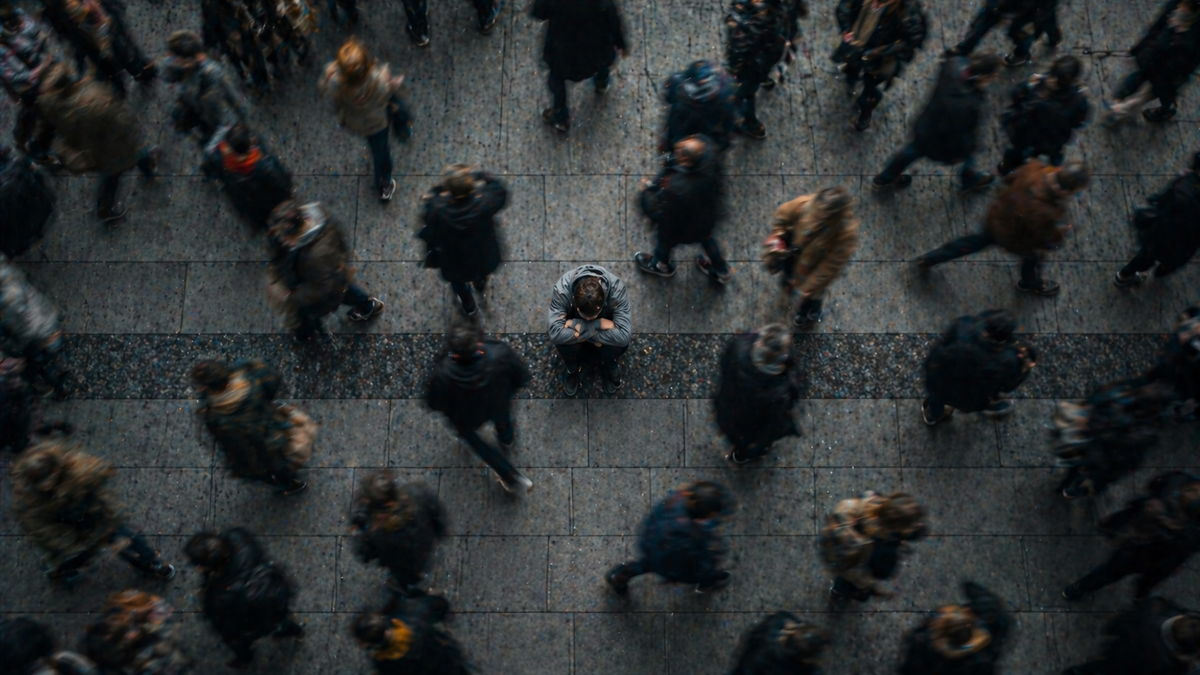
Why crowds of people can watch someone in need and do nothing to help.
Plausibility Index: 4.6/5 — Rock Solid
Decades of rigorous experiments and real-world observations consistently demonstrate this counterintuitive social phenomenon.
The quick version
When you're in a crowd and see someone in trouble, you're actually less likely to help than if you were alone. This happens because responsibility gets diffused among all the witnesses, everyone assumes someone else will act, and social cues suggest the situation might not be as serious as it appears.
Origin story
At 3:20 AM on March 13, 1964, Kitty Genovese was returning home from work in Queens, New York, when a man attacked her outside her apartment building. What happened next would spark one of psychology's most important discoveries. According to initial reports, 38 neighbors heard her screams for help during the 30-minute assault, yet no one called police or intervened.
The story horrified America. How could so many people witness a murder and do nothing? The New York Times headline read "37 Who Saw Murder Didn't Call the Police," and the nation wrestled with what seemed like urban callousness and moral decay.
But two young psychologists, John Darley and Bibb Latané, suspected something deeper was at play. Rather than assuming people were inherently selfish or apathetic, they wondered if the presence of other witnesses might actually inhibit helping behavior. In 1968, they designed a series of elegant experiments that would revolutionize our understanding of human nature.
Their first study was brilliantly simple. They had participants sit in separate rooms, supposedly discussing personal problems over an intercom system. During the conversation, one participant (actually a confederate) staged a seizure, crying for help. The key variable? Whether participants thought they were the only witness or if others were also listening. The results were stunning: when people thought they were alone, 85% rushed to help. When they believed four others were also listening, only 31% helped.
What Darley and Latané had discovered wasn't human cruelty—it was an unexpected quirk of social psychology that they named the bystander effect.
How it works
The bystander effect operates through three psychological mechanisms that work together to paralyze potential helpers. Think of it like a perfect storm of social confusion.
First is diffusion of responsibility. When you're alone and see someone in trouble, the responsibility to act falls squarely on your shoulders. But add other people to the scene, and suddenly that weight gets distributed. Your brain unconsciously calculates: "Well, there are five other people here, so I'm only 1/6th responsible." It's like being part of a group project where everyone assumes someone else will do the work.
Second is pluralistic ignorance—essentially, everyone looking to everyone else for cues about how serious the situation really is. In emergencies, people often don't scream "HELP!" like in movies. A heart attack victim might just slump over quietly. A person being harassed might not fight back dramatically. So witnesses scan other faces for reactions. But here's the catch: everyone else is also trying to appear calm and collected, creating a feedback loop where everyone thinks everyone else thinks it's not a big deal.
The third mechanism is evaluation apprehension—fear of looking foolish. What if you rush to help someone who's just drunk, not having a medical emergency? What if you misread the situation and embarrass yourself? When you're alone, this social cost disappears. But in a crowd, the potential for public humiliation can be paralyzing.
These three forces combine to create a situation where the very people who could help become frozen by each other's presence. It's not that people become less caring in groups—they become less certain about what care looks like.
Real-world examples
The Hugo Alfredo Tale-Yax Case
In 2010, Hugo Alfredo Tale-Yax was stabbed while trying to help a woman being attacked in Queens, New York. Surveillance footage showed him lying bleeding on the sidewalk for over an hour while more than 20 people walked past, stepped over him, and even photographed him. One person briefly shook him, then walked away. Tale-Yax died on the pavement. The case sparked renewed discussion about urban apathy, but psychologists pointed to classic bystander effect dynamics: with so many potential helpers, each person assumed someone else would take responsibility.
The 2008 Financial Crisis and Regulatory Oversight
The bystander effect doesn't just apply to physical emergencies—it shows up in institutional failures too. Before the 2008 financial crisis, numerous regulatory agencies (SEC, Federal Reserve, OCC, others) all had overlapping authority to monitor risky banking practices. Each agency assumed the others were handling oversight, creating a diffusion of responsibility that allowed dangerous practices to flourish. No single agency felt fully accountable for preventing systemic risk, demonstrating how the bystander effect can scale up to catastrophic institutional levels.
Online Harassment and Digital Bystanders
The bystander effect has found new life in digital spaces. When someone is being harassed or bullied online, the presence of many observers can actually reduce intervention rates. A 2019 study found that people were less likely to report cyberbullying when they could see that many others had already viewed the harmful content. The logic was familiar: surely someone else among the hundreds of viewers would report it. This digital diffusion of responsibility has made online harassment more persistent and harder to combat through community self-policing.
Criticisms and limitations
The bystander effect research has faced significant scrutiny, starting with its foundational case. Modern investigation of the Kitty Genovese murder revealed that the original New York Times reporting was substantially inaccurate. Far fewer people actually witnessed the attack than reported, some did call police, and the situation was much more ambiguous to observers than initially described. This doesn't invalidate the psychological phenomenon, but it highlights how a compelling narrative can sometimes outrun the facts.
Cultural context matters enormously, and most bystander effect research has been conducted on Western, educated populations. Studies in more collectivist cultures sometimes show different patterns, with group presence occasionally increasing helping behavior rather than decreasing it. The effect also varies significantly based on the type of emergency, the relationship between bystanders, and whether the situation is clearly defined as an emergency.
Some researchers argue that the laboratory studies, while methodologically sound, may not capture the complexity of real-world emergencies. Staged emergencies in controlled settings can't fully replicate the chaos, ambiguity, and genuine fear that characterize actual crises. Additionally, modern technology has changed the landscape—cell phones make it easier to call for help, but they also create new forms of bystander behavior, like filming instead of helping.
Perhaps most importantly, the bystander effect isn't inevitable. Research shows it can be overcome through education, clear role assignment, and situational factors that increase personal responsibility. Critics worry that overemphasizing the effect might actually make it worse by convincing people that inaction in groups is normal and expected.
Related theories
Diffusion of Responsibility
The core mechanism underlying the bystander effect—how individual accountability decreases in groups.
Pluralistic Ignorance
Explains why bystanders often misread emergency situations by looking to others who are also confused.
Social Proof
The tendency to follow others' behavior can reinforce bystander inaction when everyone appears calm.
Go deeper
The Unresponsive Bystander: Why Doesn't He Help? by Bibb Latané and John Darley (1970) — The foundational text by the researchers who discovered and named the effect.
Kitty Genovese: The Murder, the Bystanders, the Crime That Changed America by Kevin Cook (2014) — A thorough investigation that separates myth from reality in the case that inspired bystander effect research.
Group Inhibition of Bystander Intervention in Emergencies by Bibb Latané and John Darley (1968) — The original experimental study that first demonstrated the bystander effect in laboratory conditions.
Footnotes
- The original Kitty Genovese case involved far fewer witnesses than initially reported, but the psychological phenomenon it inspired studying remains well-documented.
- Modern smartphone technology has created new dynamics in bystander situations, with people sometimes filming emergencies rather than helping.
- Training programs for bystander intervention have shown success in reducing the effect, particularly in contexts like sexual assault prevention.