Swiss Cheese Model
The Swiss Cheese Model explains how accidents happen when holes in multiple safety barriers align, allowing hazards to slip through.
Why disasters happen when multiple safety barriers fail at once.
Plausibility Index: 4.6/5 — Rock Solid
Widely validated across industries with decades of successful application in aviation, healthcare, and nuclear safety.
The quick version
Every safety system has weaknesses—like holes in Swiss cheese. Usually these holes don't line up, so problems get caught. But when multiple barriers fail simultaneously and their 'holes' align, disasters can slip through undetected.
Origin story
In the 1990s, psychologist James Reason was trying to solve a puzzle that haunted safety experts: why do catastrophic accidents happen in systems designed to prevent them? Airlines had multiple backup systems, hospitals had extensive protocols, nuclear plants had redundant safety measures. Yet disasters still occurred.
Reason noticed something crucial while studying accident reports. It wasn't that safety systems were fundamentally broken—it's that they all had small, seemingly harmless gaps. Like slices of Swiss cheese, each barrier had holes. The magic happened when you stacked multiple barriers together: even if one slice had holes, the others would catch what slipped through.
The breakthrough insight came from studying near-misses. In most cases, problems were caught by secondary or tertiary safety systems, even when the first line of defense failed. But in the rare cases where accidents occurred, investigators found the same pattern: multiple barriers had failed simultaneously, and their weaknesses had aligned like a tragic constellation.
Reason published his Swiss Cheese Model in 1997, and it revolutionized how organizations think about safety. Instead of looking for single causes or scapegoats, the model encouraged systems thinking about how multiple small failures could combine into big disasters.
How it works
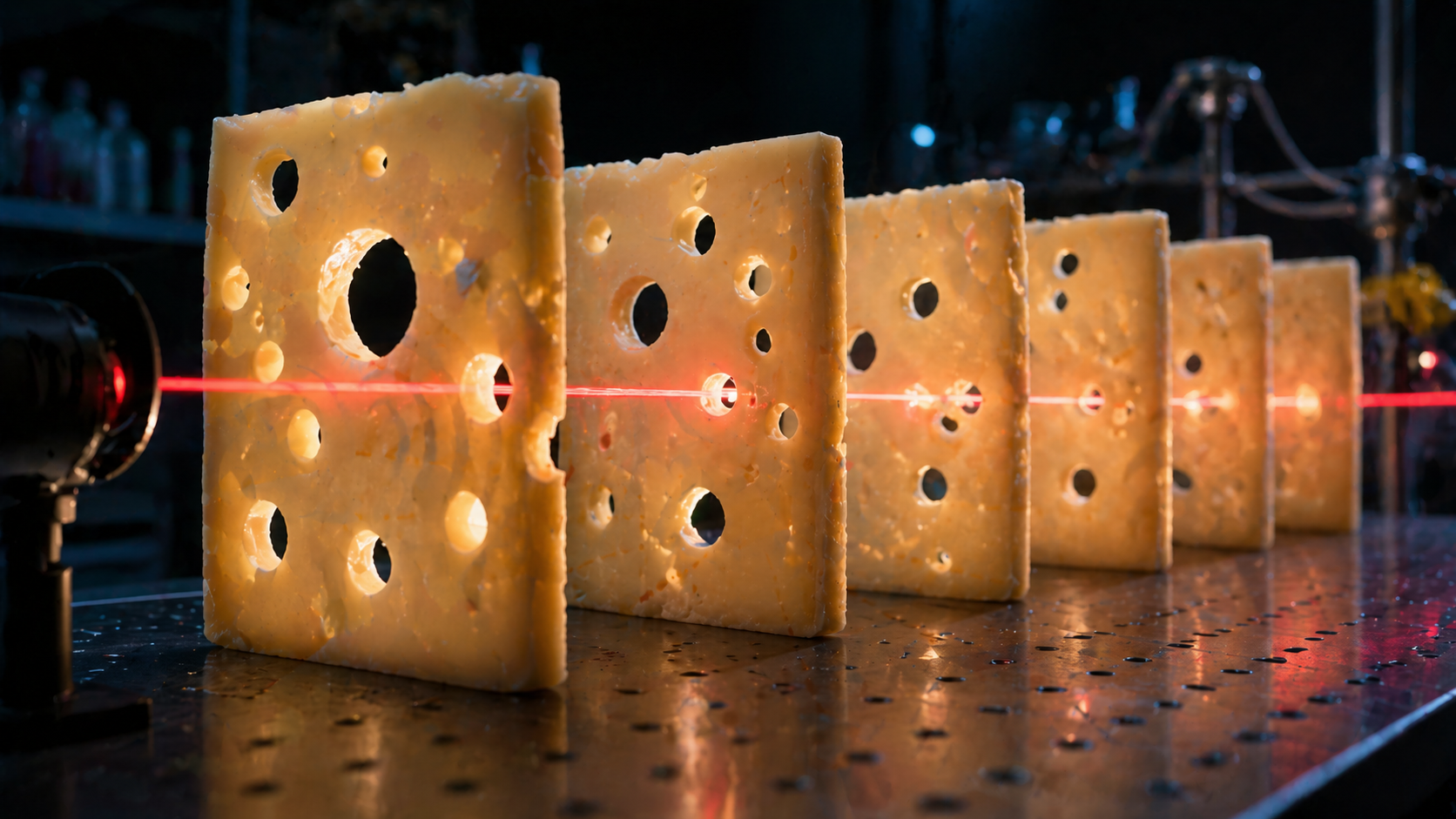
Imagine you're holding several slices of Swiss cheese up to the light. Each slice represents a different safety barrier—training protocols, equipment checks, supervision, technology safeguards. The holes in each slice represent the weaknesses or gaps in that particular barrier.
When you hold just one slice up, you can see right through the holes. That's why no single safety measure is ever enough. But stack multiple slices together, and something interesting happens: the holes rarely line up perfectly. Light (or in our case, hazards) gets blocked by the solid parts of other slices.
The model identifies two types of failures that create these holes. Active failures are the obvious ones—a pilot makes an error, a nurse gives the wrong medication, an operator pushes the wrong button. These are like temporary holes that appear and disappear based on human actions.
But the more dangerous holes are latent conditions—systemic weaknesses that exist long before any accident occurs. Poor training programs, inadequate equipment maintenance, time pressures, unclear procedures, or organizational cultures that discourage reporting problems. These create permanent holes that sit waiting for the right moment.
Disaster strikes when active failures occur in a system already weakened by latent conditions, causing multiple barriers to fail simultaneously. It's like a perfect storm where all the cheese holes align, creating a clear path for the hazard to travel from source to victim.
Real-world examples
The Challenger Space Shuttle Disaster
On January 28, 1986, the Space Shuttle Challenger exploded 73 seconds after launch, killing all seven crew members. The Swiss Cheese Model reveals how multiple barriers failed simultaneously. The immediate cause was O-ring failure in cold weather (active failure), but the holes had been aligning for months. NASA had a culture that discouraged dissent (latent condition), engineers' safety concerns were overruled by schedule pressure (latent condition), and the decision-making process bypassed normal safety protocols (latent condition). Any one of these barriers working properly could have prevented the tragedy.
Hospital Medication Errors
A patient receives a dangerous drug overdose despite multiple safety checks. The Swiss cheese holes aligned: the doctor wrote an unclear prescription (active failure), the pharmacy software didn't flag the dangerous dosage because it wasn't updated (latent condition), the nurse was working a double shift and missed the warning signs (latent condition), and the hospital's understaffing meant no one double-checked the medication (latent condition). Each barrier had a hole, and this time they all lined up.
The 2008 Financial Crisis
The global financial meltdown wasn't caused by one rogue trader or single bad decision—it was Swiss cheese in action. Multiple safety barriers failed: credit rating agencies gave inflated ratings (latent condition), banks ignored their own risk models (active failure), regulators reduced oversight (latent condition), and mortgage brokers had incentives to approve risky loans (latent condition). When housing prices finally dropped, all these holes aligned, allowing systemic risk to cascade through the entire global financial system.
Criticisms and limitations
Critics argue that the Swiss Cheese Model can become an excuse for inaction. Organizations sometimes use it to justify accepting risk by saying 'we have multiple barriers,' without addressing obvious weaknesses in individual layers. It's like saying your house is secure because you have multiple locks while ignoring that one of your windows is wide open.
The model also struggles with dynamic, rapidly changing situations where the 'cheese slices' are constantly shifting. In cybersecurity, for example, new threats emerge daily, and yesterday's solid barrier might have new holes by tomorrow. The static metaphor doesn't capture how modern systems need to adapt and evolve their defenses continuously.
Some safety experts worry that the model encourages a reactive rather than proactive approach. Teams might wait for near-misses to reveal where holes are aligning instead of actively hunting for latent conditions. There's also a risk of 'barrier proliferation'—adding more and more layers without improving the quality of existing ones.
Finally, the model can oversimplify human factors. Real people don't just create random 'holes'—they make predictable errors under predictable conditions. Modern safety science increasingly focuses on designing systems that work with human psychology rather than against it.
Related theories
Normal Accident Theory
Explains why some systems are inherently prone to Swiss cheese failures due to tight coupling and complexity.
Murphy's Law
Provides the pessimistic foundation that Swiss cheese holes will eventually align if given enough time.
Defense in Depth
The strategic principle of layering multiple security barriers that Swiss cheese modeling helps analyze and improve.
Go deeper
Human Error by James Reason (1990) — The foundational work that introduced the Swiss Cheese Model to the world.
Managing the Risks of Organizational Accidents by James Reason (1997) — Practical application of Swiss cheese thinking to organizational safety management.
The Field Guide to Understanding Human Error by Sidney Dekker (2014) — Modern critique and evolution of Reason's work with more nuanced view of human factors.
Footnotes
- The original Swiss Cheese Model paper has been cited over 15,000 times in safety literature.
- Aviation has reduced accident rates by 95% since adopting Swiss cheese thinking in the 1990s.
- The model is now mandated training in most healthcare systems worldwide.