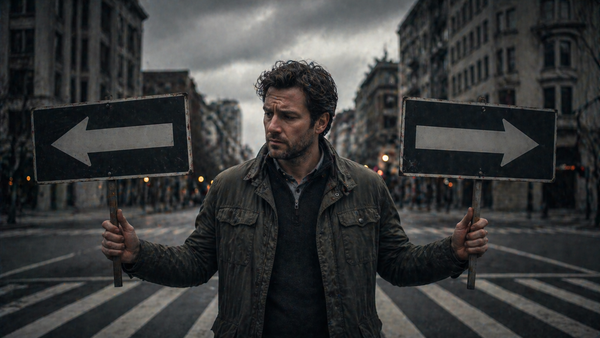
The Trolley Problem
A thought experiment that exposes the hidden contradictions in how we make moral decisions by asking whether you'd kill one person to save five.
The thought experiment that reveals how we really make moral decisions.
Plausibility Index: 4.7/5 — Rock Solid
Decades of research consistently show the psychological patterns it reveals, making it a foundational tool for understanding moral reasoning.
The quick version
You see a runaway trolley heading toward five people on the tracks—do you pull a lever to divert it, killing one person instead? Most people say yes. But what if you had to push a large person off a bridge to stop the trolley? Most people say no, even though the math is identical. This reveals that our moral intuitions aren't as rational as we think.
Origin story
The Trolley Problem emerged from a very British philosophical tradition of asking uncomfortable questions over tea. In 1967, philosopher Philippa Foot introduced the basic scenario as part of a larger discussion about the morality of abortion. She wasn't trying to create the most famous thought experiment in philosophy—she was just exploring when it might be acceptable to cause harm as a side effect of preventing greater harm.
But it was Judith Jarvis Thomson who really put the trolley on the philosophical map in 1976. Thomson added the crucial twist: the fat man variant (now more diplomatically called the "large person" scenario). She noticed something fascinating—people's moral intuitions flip dramatically between the two scenarios, even though the utilitarian math is identical. Kill one to save five? Sometimes yes, sometimes absolutely not.
What started as an academic curiosity became a phenomenon when psychologists got involved in the 1990s. Suddenly, researchers could study moral decision-making in the lab, watching people's brains light up as they wrestled with imaginary trolleys. The thought experiment escaped philosophy departments and invaded everything from business ethics courses to self-driving car programming discussions.
The timing was perfect. As technology advanced and we faced new moral dilemmas—from autonomous vehicles to medical triage algorithms—the Trolley Problem offered a framework for thinking about life-and-death decisions. It turns out that a 1960s philosophical thought experiment was exactly what we needed to understand 21st-century moral challenges.
How it works
The Trolley Problem works by creating two scenarios that are mathematically identical but psychologically different. In both cases, you can save five lives by sacrificing one. But your brain processes these situations completely differently, revealing the hidden machinery of moral reasoning.
In the classic lever scenario, you're pulling a switch to redirect the trolley. The death of the one person feels like a side effect—terrible, but not the primary action. You're saving five people, and unfortunately, one person dies as a consequence. This triggers what psychologists call "utilitarian reasoning"—you're calculating the greatest good for the greatest number.
But in the bridge scenario, you're actively pushing someone to their death. Even though the outcome is identical, this feels like murder. The person's death isn't a side effect; it's the means to your end. This activates what researchers call "deontological thinking"—the sense that some actions are inherently wrong, regardless of consequences.
The genius of the Trolley Problem is that it isolates this psychological difference. It strips away all the usual variables—relationships, uncertainty, self-interest—and focuses purely on the mechanics of moral judgment. Your brain has two moral systems: one that calculates outcomes and one that follows rules about right and wrong actions. Usually they work together, but the trolley scenarios pit them against each other.
This isn't just academic navel-gazing. The same psychological patterns show up everywhere: medical decisions, business ethics, policy-making. Understanding why we react differently to these scenarios helps explain why moral disagreements are so persistent and why ethical decision-making is so much harder than we think it should be.
Real-world examples
Self-Driving Car Programming
Engineers at companies like Tesla and Waymo face literal trolley problems when programming autonomous vehicles. Should a car swerve to avoid five pedestrians if it means hitting one? The algorithms they write embody moral choices, and they're discovering that public opinion varies dramatically based on how the scenario is framed. People are more comfortable with cars that "allow" harm through inaction than cars that "cause" harm through deliberate action, even when the math is identical.
COVID-19 Ventilator Allocation
During the pandemic, hospitals faced real-world trolley problems when ventilators were scarce. Medical ethicists debated whether to prioritize patients most likely to survive (utilitarian thinking) or treat patients first-come-first-served (deontological thinking). The psychological research on trolley problems helped explain why healthcare workers felt so differently about withholding treatment versus withdrawing it, even when both decisions could save more lives overall.
Military Drone Strikes
The trolley problem psychology appears in military ethics too. Pilots report feeling differently about drone strikes that target enemy combatants (with civilian casualties as side effects) versus strikes that deliberately target civilians to demoralize the enemy—even when strategists argue both could save more lives in the long run. The distinction between intended and merely foreseen consequences drives real policy decisions about rules of engagement.
Criticisms and limitations
The biggest criticism of the Trolley Problem is that it's too artificial to tell us anything meaningful about real-world ethics. Critics argue that stripping away context, relationships, and uncertainty creates scenarios so abstract they bear no resemblance to actual moral decisions. When did you last encounter a runaway trolley, much less have perfect information about the consequences of your actions?
There's also the "moral expertise" problem. Just because most people have certain intuitions doesn't mean those intuitions are correct. Maybe the fact that people react differently to the lever and bridge scenarios reveals a cognitive bias we should overcome, not a deep truth about ethics we should respect. Some philosophers argue we should train ourselves to think more consistently, not celebrate our inconsistencies.
Cultural critics point out that trolley problem research has been dominated by Western, educated populations. When researchers test the scenarios across different cultures, they find significant variations in moral intuitions. What looks like universal human psychology might just be the psychology of philosophy undergraduates at elite universities.
Perhaps most importantly, the Trolley Problem might be asking the wrong questions entirely. By focusing on individual decision-making in crisis scenarios, it ignores systemic issues, prevention, and collective responsibility. Real ethical progress often comes from changing systems so that trolley-like dilemmas don't arise in the first place—better urban planning, safer transportation, more equitable resource distribution. The thought experiment's focus on dramatic individual choices might distract from these more important but less exciting moral challenges.
Related theories
Dual Process Theory
Explains the psychological mechanism behind trolley problem responses through System 1 (emotional) versus System 2 (rational) thinking.
Utilitarianism
The philosophical framework that would consistently choose to save five lives over one in both trolley scenarios.
Deontological Ethics
The rule-based ethical system that explains why pushing someone feels different from pulling a lever, regardless of consequences.
Go deeper
The Righteous Mind by Jonathan Haidt (2012) — Explores the psychology behind moral decision-making with extensive discussion of trolley problem research.
Moral Tribes by Joshua Greene (2013) — Written by a key researcher in trolley problem psychology, bridging philosophy and neuroscience.
The Problem of Abortion and the Doctrine of Double Effect by Philippa Foot (1967) — The original paper that introduced the trolley scenario to philosophy.
Footnotes
- The trolley problem has generated over 1,000 academic papers and counting, making it one of the most studied scenarios in experimental philosophy.
- Brain imaging studies show that trolley dilemmas activate both emotional centers (like the amygdala) and reasoning centers (like the prefrontal cortex), with the balance determining people's choices.
- Some researchers have created virtual reality versions of the trolley problem to make it more immersive, finding that people's responses change when they feel more present in the scenario.