
Dunning-Kruger Effect
People with low ability in a domain consistently overestimate their competence, while experts tend to underestimate theirs.
People with low ability in a domain consistently overestimate their competence, while experts tend to underestimate theirs.
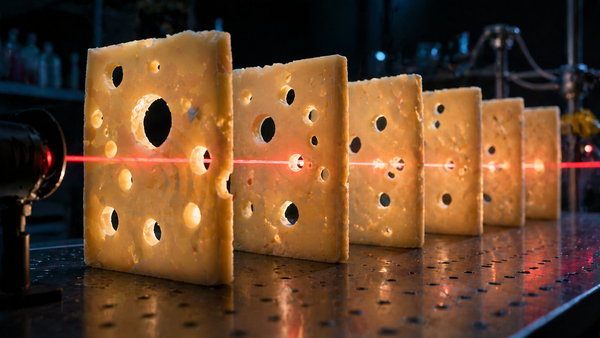
The Swiss Cheese Model explains how accidents happen when holes in multiple safety barriers align, allowing hazards to slip through.

The halo effect is our tendency to let one positive trait overshadow and influence our judgment of all other traits.

Cognitive dissonance is the uncomfortable mental tension you feel when holding contradictory beliefs, values, or attitudes simultaneously.

The more people who witness an emergency, the less likely any individual is to help.

Maslow's Hierarchy suggests humans have five levels of needs that must be satisfied in order, from basic survival to self-fulfillment.

Nash Equilibrium is the point in any strategic situation where no player can improve their outcome by unilaterally changing their strategy.

The Pareto Principle states that roughly 80% of effects come from 20% of causes.

Loss aversion is our tendency to feel the pain of losing something roughly twice as intensely as the pleasure of gaining the same thing.

The Prisoner's Dilemma shows how two rational people might not cooperate even when it's in their mutual interest to do so.

Opportunity cost is the value of the best alternative you give up when making a choice.

The Innovator's Dilemma explains why successful companies often fail not despite doing everything right, but because of it.

Business & Strategy
In hierarchical organizations, employees tend to be promoted until they reach a position where they can no longer perform competently.

Technology & Innovation
Network effects occur when a product or service becomes more valuable as more people use it.

Economics & Decision-Making
Goodhart's Law explains why metrics lose their usefulness the moment you start optimizing for them directly.

Business & Strategy
First-mover advantage is the competitive edge companies gain by being the first to enter a new market or introduce a new product category.

Science & Systems
The butterfly effect describes how tiny initial changes in complex systems can lead to dramatically different outcomes.

Economics & Decisions
Black Swan Theory explains how rare, unpredictable events with massive impact shape our world far more than we realize.

Philosophy & Ethics
Occam's Razor is the principle that the simplest explanation that fits the facts is usually the correct one.

Science & Systems
Feedback loops occur when outputs of a system circle back as inputs, creating self-reinforcing or self-correcting patterns.
Economics & Decisions
The Cobra Effect occurs when an attempted solution to a problem makes the problem worse.
Economics & Decisions
Making something more efficient often leads to using more of it, not less, because efficiency makes it cheaper and more attractive to use.
Technology & Innovation
Moore's Law predicts that the number of transistors on a computer chip doubles roughly every two years, driving exponential improvements in computing power.
Technology & Innovation
The Gartner Hype Cycle maps how new technologies move through predictable stages of inflated expectations, crushing disappointment, and eventual practical adoption.